Choosing the right Metro Mulch Perth can make a noticeable difference to how well a Perth garden handles hot summers, sandy soil and changing rainfall. The right material can help retain soil moisture, suppress weeds, moderate soil temperatures and create a more attractive finish around plants. However, not every mulch performs the same way, and the best choice depends on what you are growing, how much maintenance you want to do and how you plan to use your outdoor space.
For homeowners comparing organic mulch with wood chips, the decision is not simply about appearance or price. It is about understanding how each material behaves once it is spread across a garden bed.
At Sand Supplies Perth, we recognise that selecting the right garden material starts with understanding your property’s needs. Whether you are refreshing established garden beds, improving a new landscape or looking for Affordable bulk mulch delivery Perth, comparing mulch types before ordering can help you make a more informed decision.
In this guide, we explain the differences between organic mulch and wood chips, their practical benefits and limitations, and how to choose a suitable option for Perth’s growing conditions.
Before deciding which option is better, it helps to understand what these materials are, how they break down and what they contribute to the garden.
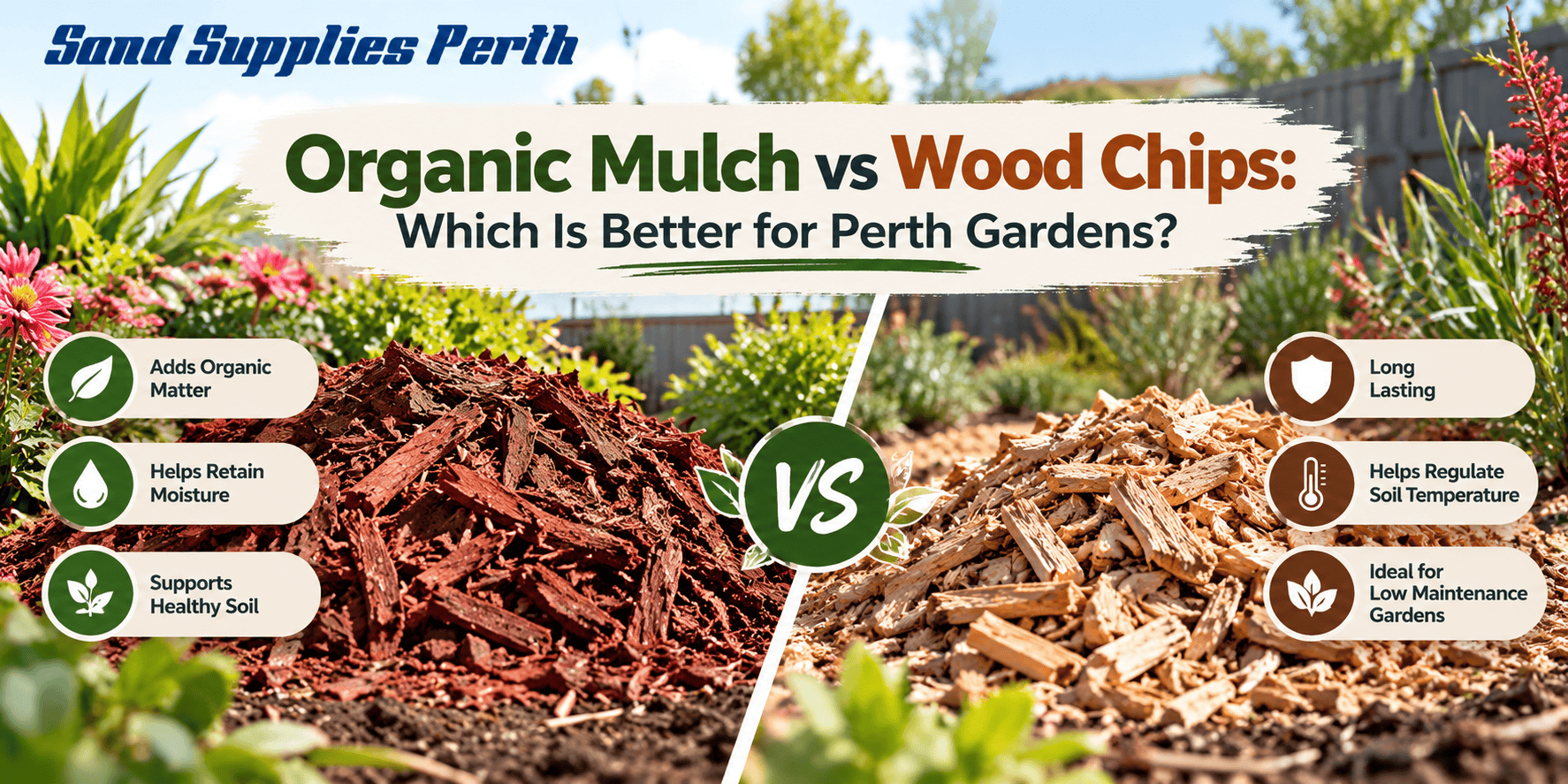
Although the terms are sometimes used interchangeably, organic mulch is a broad category, while wood chips are one particular type of organic mulching material.
Organic mulch is made from natural materials that gradually decompose. Depending on the product, it may include processed bark, leaves, plant matter, composted organic material or other suitable garden residues.
As organic mulch breaks down, it can contribute organic matter to the soil and support beneficial soil organisms. It also provides a protective surface layer that reduces direct exposure to sunlight and slows evaporation.
For Perth gardens, these characteristics can be particularly useful because sandy soils generally drain quickly and have limited capacity to retain water and nutrients. Improving soil organic matter, alongside appropriate soil conditioning, can help create a more favourable growing environment.
Organic mulch is often a practical choice for:
One important consideration is the composition of the mulch. Different organic materials decompose at different rates, so the term organic mulch alone does not tell you how long a particular product will last or how much it will contribute to soil improvement.
Wood chips are pieces of chipped or shredded wood used to cover exposed soil. Depending on the product, they may come from processed timber-free garden vegetation, branches, bark or other suitable woody materials.
Their relatively coarse structure makes many wood-chip products useful for covering larger garden beds. Coarser materials can also be more durable than finer mulches because they generally break down more slowly.
Common applications include:
However, wood chips are not all the same. Their particle size, source, age and processing can affect their performance. Fresh, high-carbon woody material may temporarily immobilise nitrogen when mixed into the soil, which is one reason to use it primarily as a surface mulch rather than digging it into the root zone.
For Perth gardens, the best choice depends on whether you prioritise soil improvement, surface coverage, durability or a particular landscape appearance.
Both materials can help protect garden soil, but their practical performance varies.
| Feature | Organic mulch | Wood chips |
| Soil improvement | Depends on composition and decomposition rate | Can contribute organic matter gradually |
| Moisture retention | Helps reduce evaporation when applied correctly | Coarse chips can provide an effective moisture-protective layer |
| Weed suppression | Effective with suitable coverage and depth | Effective when coverage is even and gaps are minimised |
| Longevity | Varies; finer materials often break down faster | Often relatively durable, depending on chip size and material |
| Appearance | May offer a finer, more uniform finish | Typically creates a textured, natural finish |
| Best applications | General garden beds and soil-building projects | Established trees, shrubs and larger ornamental beds |
These are general comparisons, not guarantees for every product. A well-processed woody mulch may perform better than a poorly prepared finer mulch, while a suitable finer organic material may be preferable where rapid decomposition is desirable.
For mulch for sandy soil, the first priority is to reduce moisture loss while improving the soil over time.
Perth’s sandy soils can have low water- and nutrient-holding capacity. When soil becomes water-repellent, irrigation may also fail to penetrate evenly. Mulch helps protect the surface, but it does not independently correct every soil problem.
Consider the following approach:
There is no single material that is automatically best for every Perth garden. Plant species, soil condition, irrigation practices and maintenance requirements all influence the outcome.
Organic mulch can do more than make a garden look finished. When correctly selected and maintained, it contributes to several practical aspects of garden management.
Bare soil is directly exposed to sunlight, air movement and changing temperatures. A suitable mulch layer reduces evaporation from the surface, helping the soil remain moist for longer between watering sessions.
This makes organic mulch a useful component of a water-saving garden strategy. The Water Corporation recommends applying approximately 5–10 cm of suitable waterwise mulch, with coarse materials often offering advantages over softer, finer products for water conservation.
However, mulch does not eliminate the need for irrigation. During Perth’s hot, dry summer weather, plants may still require careful watering based on their species, root development and local conditions.
Weeds compete with garden plants for water, nutrients, sunlight and growing space.
A consistent layer of mulch reduces the amount of light reaching the soil surface, making it harder for many weed seeds to establish. It also makes some weeds that do emerge easier to remove.
For better results:
Mulch cannot prevent every weed. Persistent perennial weeds may grow through the layer, and wind-blown seeds can germinate on top of it.
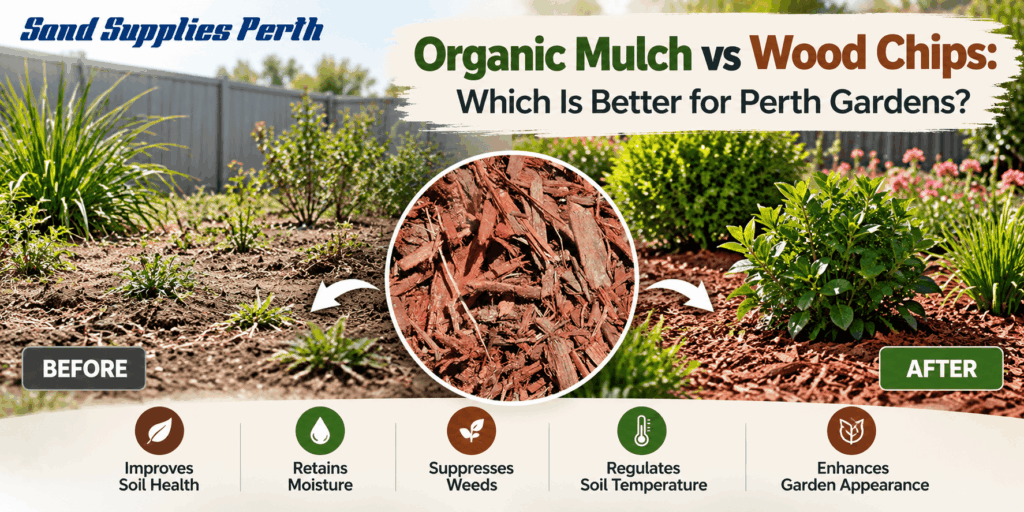
Perth’s summer conditions can expose shallow roots to high soil temperatures, particularly in newly landscaped areas with little shade.
Mulch provides a protective layer between the soil and the atmosphere. This can reduce temperature fluctuations and create more stable conditions around plant roots.
This benefit is especially relevant to young shrubs, newly established planting beds and landscapes where the soil surface receives direct afternoon sunlight.
As suitable organic mulch decomposes, it contributes organic matter to the soil. Over time, this can support soil organisms and help improve the growing environment.
The rate of improvement depends on the material, existing soil condition, moisture and biological activity. A surface mulch should not be treated as a substitute for compost or soil conditioner where substantial soil improvement is needed.
For new garden beds, consider improving the soil before planting and applying mulch afterwards. This allows the soil preparation and surface protection stages to work together.
Wood chips can be a sensible choice when the main objective is durable ground coverage rather than rapid decomposition.
Established trees and shrubs often benefit from a broad, mulched root zone. Coarse wood chips can help reduce evaporation, limit weed growth and protect the soil surface.
Spread the material across the appropriate root zone, while keeping it away from the trunk and main stems. Piling wood chips against bark can keep the base excessively damp and increase the risk of decay.
For young trees, the mulch should form a broad, shallow layer rather than a mound around the trunk.
A large ornamental garden can require a substantial quantity of mulch. Wood chips may be suitable where the aim is to cover extensive planting areas with a natural, textured finish.
Before choosing a product, consider:
For larger projects, ordering an appropriate quantity in bulk can simplify planning. Sand Supplies Perth can be considered as part of your material-sourcing process, subject to confirming current product availability, specifications and delivery arrangements.
Fresh wood chips are not automatically suitable for every garden bed. Their composition and maturity matter.
Use extra care when choosing wood chips for:
The practical distinction is important: using wood chips on top of the soil is different from incorporating them into it. Surface application generally reduces direct competition between decomposing wood and plant roots for soil nitrogen.
When researching Metro Mulch Perth, it is worth looking beyond the product name and comparing the characteristics that affect performance in your garden.
The right material should suit the plants, the condition of the soil and the amount of maintenance you can realistically provide. A mulch that works well beneath established trees may not be the best choice for a vegetable patch or a newly planted native garden.
Use this checklist before selecting a product from a Perth mulch supplier.
Ask what the mulch is made from and whether it has been processed or aged. A consistent, suitable product is generally easier to spread and maintain than material containing excessive debris or a mixture of unsuitable particles.
For organic mulch and wood chips, check for:
Where product certification or suitability standards matter, ask the supplier for supporting information rather than assuming every bulk mulch product meets the same specification.
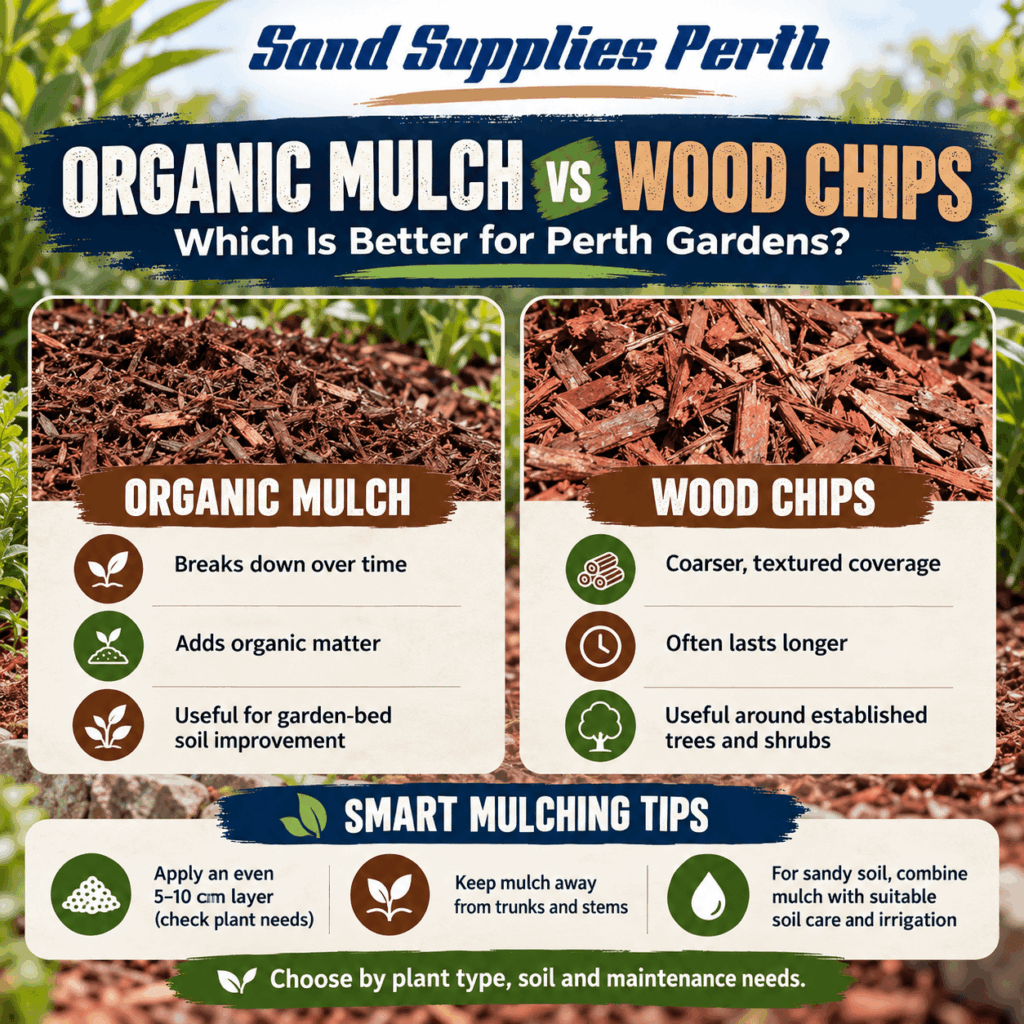
Different parts of the same property may need different materials.
For example, a front garden containing established ornamental shrubs may benefit from coarse wood chips, while a smaller planting bed may be better suited to a finer organic mulch.
Likewise, a vegetable garden needs a material compatible with edible crops and the garden’s nutrient-management requirements.
Choosing by application instead of appearance alone can help you avoid unnecessary replacement and maintenance.
The cheapest mulch is not always the most economical choice.
Consider the quantity needed, delivery charges, material quality, expected durability and the effort required to spread or replenish it. A product that lasts longer may offer better value in a low-maintenance landscape, while a faster-decomposing material may be more appropriate where gradual soil improvement is the priority.
For larger projects, Affordable bulk mulch delivery Perth is a useful purchasing consideration because delivery costs and order quantities can influence the overall landscaping budget.
Before placing an order with Sand Supplies Perth, confirm the available mulch options, current pricing, minimum order requirements and delivery arrangements for your location.
Calculating the required quantity before ordering helps prevent shortages, unnecessary costs and leftover material.
The basic calculation is:
Volume(m3)=Area(m2)Depth(m)
For example, suppose you have a garden bed measuring 20 square metres and want to apply mulch at a depth of 75 mm.
200.075=1.5m3
You would need approximately 1.5 cubic metres of mulch to cover that area at the intended depth, before allowing for uneven ground, settling or any additional material required.
Here are some other examples:
| Garden area | Mulch depth | Approximate quantity |
| 10 m² | 50 mm | 0.5 m³ |
| 20 m² | 75 mm | 1.5 m³ |
| 30 m² | 75 mm | 2.25 m³ |
| 40 m² | 100 mm | 4 m³ |
These figures are mathematical estimates, not supplier-specific load or coverage guarantees.
For most general garden applications, the Water Corporation recommends a mulch depth of approximately 5–10 cm. Choose the appropriate depth based on the material, planting conditions and product guidance.
Avoid automatically applying the maximum depth everywhere. Excessive mulch can interfere with air exchange, bury low-growing plants or create problems around stems and trunks.
Selecting the right product is only part of the process. Proper application is essential if you want to get the most from your water saving mulch.
Remove existing weeds, sticks and unwanted debris. If the soil is compacted or water-repellent, address those issues before mulching.
For sandy soil, appropriate soil conditioners, compost and wetting agents may help improve moisture and nutrient management. Follow the relevant product instructions and consider the needs of the plants already growing in the bed.
If the ground is very dry, water it before applying mulch so that the material does not simply cover an already dry root zone.
Check that water is penetrating the soil rather than running off or moving through only a few channels.
Distribute the mulch consistently across the intended area. Break up obvious piles and avoid leaving large gaps of bare soil.
For most general garden beds, a depth of 50–100 mm is a useful starting range, subject to plant requirements and the mulch product’s recommendations.
Leave a clear gap around plant stems and tree trunks. Do not build a mound against the bark or cover the root flare of a tree.
This simple precaution helps prevent persistently damp conditions at the base of the plant.
Check the garden periodically, particularly after heavy rain, strong winds or extended hot weather.
Look for:
Top up only when necessary. Existing mulch does not always need to be completely replaced.
Even a suitable product can perform poorly if it is used incorrectly.
A deeper layer is not always better. Excessive mulch can restrict airflow, cover smaller plants and create moisture problems around plant bases.
Better approach: Measure the depth instead of estimating it by eye, and keep the layer consistent with the plant’s needs.
Fresh woody material decomposes using nitrogen, and incorporating it into the root zone can temporarily reduce nitrogen availability to plants.
Better approach: Generally keep wood chips on the soil surface. If you need to improve the soil itself, use a suitable compost or soil conditioner.
Mulch reduces surface evaporation, but it cannot independently correct severe soil compaction, nutrient deficiencies or water repellency.
Better approach: Assess the soil first, make any necessary amendments and then apply mulch as a protective surface layer.
A visually attractive mulch may not be the best option for every planting area.
Better approach: Consider material composition, particle size, maturity, intended use and maintenance requirements alongside appearance.
An oversized order can increase costs and create storage problems, while an undersized order can interrupt the project.
Better approach: Calculate the garden’s area, choose the application depth and estimate the volume before arranging delivery.
For a more effective, lower-maintenance garden, keep these practical considerations in mind.
Choose mulch according to plant type. Local native plants, ornamental shrubs, fruit trees and vegetables can have different soil and nutrient requirements. A product suitable for one group may not be ideal for another.
Use mulch as part of a wider soil-management plan. In sandy Perth soils, moisture retention, soil conditioning and appropriate irrigation work together. Mulch is valuable, but it is not a complete soil-improvement solution.
Consider the long-term maintenance cycle. Coarser wood chips may remain visible for longer, while finer organic materials may break down more quickly. Think about how frequently you want to replenish the garden.
Check the delivery conditions. Before purchasing bulk material, confirm where the load can be placed, whether the access is suitable for the delivery vehicle and whether you can move the material to the garden bed promptly.
Buy for the project, not just the unit price. Compare the expected coverage, product suitability and total delivered cost. This is especially important when planning larger landscaping projects.
Seek product-specific advice when uncertain. If you are choosing between several mulch types, ask about their composition, intended applications and maintenance requirements before ordering.
These steps can help you select the best mulch for Perth gardens based on practical performance rather than marketing claims.
Selecting a suitable mulch is an important part of planning a garden, whether you are updating a small residential bed or preparing a larger landscaping area.
At Sand Supplies Perth, the focus of your purchasing decision should be finding a material that suits your intended application and understanding the practical requirements of getting it delivered to your property.
Before ordering, consider the following:
If you are exploring Affordable bulk mulch delivery Perth, planning these details in advance can help you make a better-informed purchase and avoid ordering material that does not suit your garden.
Product availability, pricing and delivery options should be confirmed directly with Sand Supplies Perth before making a final decision.
Organic mulch and wood chips can both be useful choices, but the better option depends on what you want your garden to achieve.
Organic mulch is worth considering when gradual soil improvement, moisture protection and a suitable decomposition rate are important. Wood chips can be a practical choice for established trees, shrubs and larger ornamental beds where durable, natural-looking surface coverage is desirable.
For Perth’s sandy soils, the most effective approach is to select a suitable product, prepare the soil where necessary, apply mulch at an appropriate depth and maintain the garden as conditions change.
When comparing Metro Mulch Perth options, look beyond the product name and focus on material quality, intended use, coverage and overall value.
Sand Supplies Perth can be part of your material-sourcing process. Before ordering, confirm which mulch products are available and which options suit your project.
The right choice is not necessarily the finest, coarsest or cheapest mulch. It is the material that meets your garden’s requirements and provides practical value over time.
Neither option is universally better. Organic mulch may be preferable when you want material that breaks down and contributes organic matter to the soil. Wood chips can be useful for established trees, shrubs and larger ornamental beds where a coarser, potentially longer-lasting surface layer is desirable. Your soil condition, plant species, irrigation practices and maintenance preferences should guide the choice.
The best mulch for Perth’s sandy soil is one that provides suitable surface coverage, reduces evaporation and matches the plants’ requirements. Coarse organic mulch is often a useful option because it protects the soil surface and can contribute organic matter as it decomposes. However, severe water repellency or poor nutrient retention may require additional soil conditioning. Mulch should therefore be part of a broader soil-management strategy rather than the only treatment.
For many general garden beds, a depth of approximately 5–10 cm is suitable, depending on the mulch and planting conditions. The Water Corporation recommends this range for waterwise mulching. Spread the material evenly, avoid covering plant stems and tree trunks, and follow any product-specific guidance. A thicker layer is not automatically more effective, especially around shallow-rooted plants or small groundcovers.
Wood chips can contribute organic matter as they decompose, but the rate of improvement depends on the material and local conditions. Their main immediate function is generally surface protection rather than rapid soil enrichment. Avoid mixing fresh wood chips directly into the root zone of actively growing plants because decomposition can temporarily affect nitrogen availability. If your garden needs more immediate soil improvement, a suitable compost or soil conditioner may be more appropriate.
Start by measuring the area you intend to cover and deciding on a suitable mulch depth. Calculate the required cubic metres, then compare available products, material specifications, total delivered prices and minimum order requirements. Check delivery access and confirm that the product is appropriate for your planting area. For Affordable bulk mulch delivery Perth, contact Sand Supplies Perth to verify current product availability, pricing and delivery arrangements before placing your order.
 0

