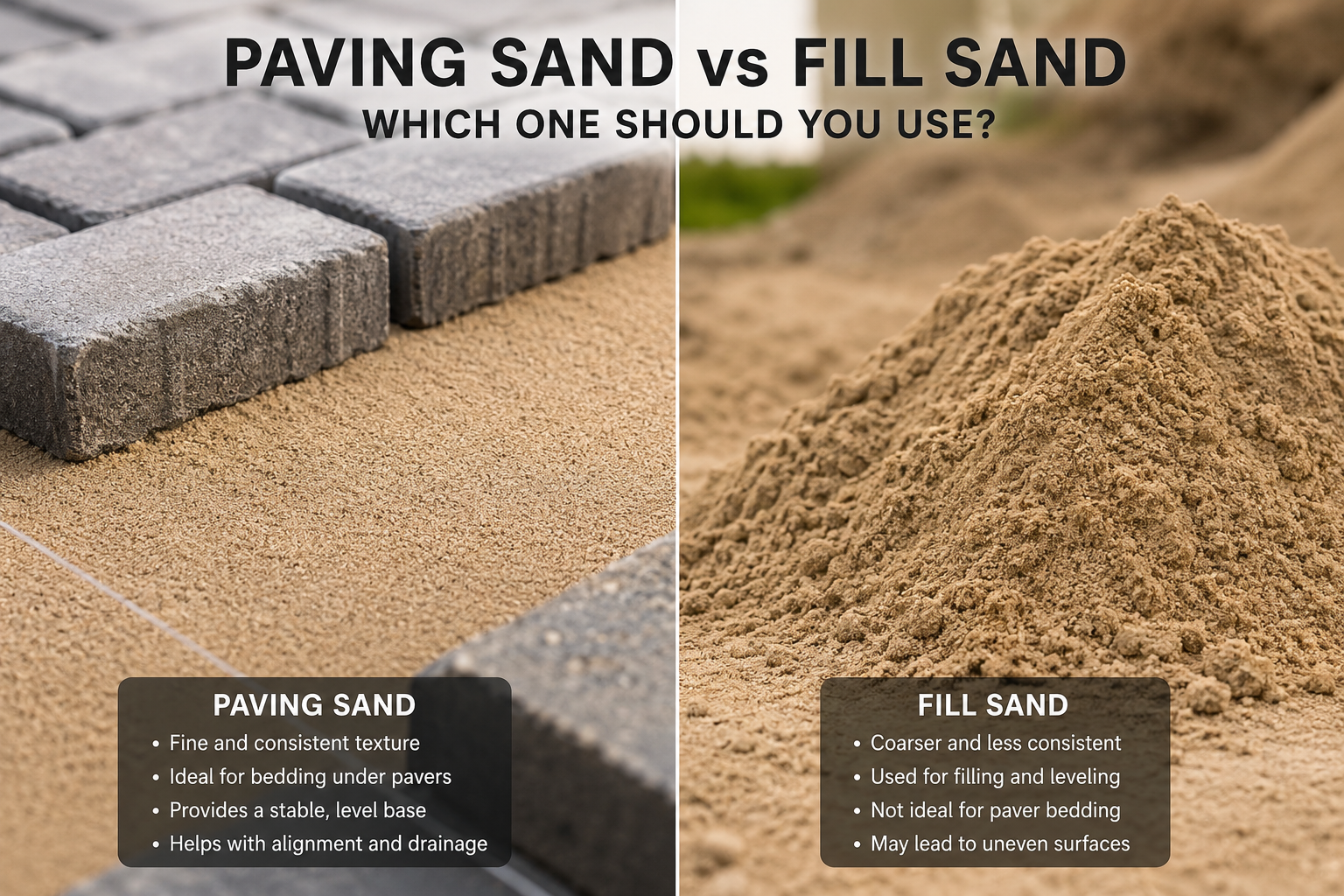
Choosing the right sand for a paving project can seem like a minor detail, but it can have a major impact on how well your finished surface performs. A patio, pathway, driveway or outdoor entertaining area may look excellent when first installed, yet problems can develop when the wrong sand is used beneath or around the pavers.
This is particularly important when sourcing Paving Sand Perth, where local projects can involve everything from residential patios and garden paths to high-traffic driveways and larger landscaping works.
One of the most common questions is whether paving sand and fill sand can be used interchangeably. The short answer is no. While both are granular materials, they are manufactured, graded and selected for different purposes.
Using fill sand as a substitute for paving bedding material can affect stability, drainage, levelling and long-term performance. On the other hand, using paving sand where a general filling material is needed can be unnecessarily expensive.
This guide explains the differences clearly, including what is paving sand, how it compares with fill sand, when each material is appropriate, and what to consider when choosing a paving sand supplier Perth homeowners, landscapers and contractors can rely on.
What Is Paving Sand?
Paving sand is a carefully graded sand commonly used in paving and landscaping applications. Its particle size, texture and consistency make it suitable for creating a stable, relatively even layer beneath certain types of pavers.
When people search for paving sand Perth, they may be referring to sand intended for different stages of a paving installation. It is therefore important to confirm exactly what the product is designed for rather than selecting material based solely on the word “sand.”
For many paving applications, the bedding layer needs to provide several functions:
The exact specification depends on the paving system, paver type, project conditions and manufacturer’s recommendations.
Why Grading Matters
Sand is not simply sand.
Particle size distribution affects how the material behaves when spread, screeded, compacted or exposed to water. A properly selected paving material should be predictable enough to produce a consistent bedding layer.
This is one reason experienced paving contractors avoid choosing sand purely because it is inexpensive or readily available.
Paving Sand vs Fill Sand at a Glance
Before getting into the details, the fundamental distinction is straightforward:
| Characteristic | Paving Sand | Fill Sand |
| Primary purpose | Paving and landscaping applications | General filling and levelling |
| Typical use | Bedding or joint-related applications depending on product | Filling low areas and general earthworks |
| Grading | Selected for specific paving requirements | Generally intended for bulk filling |
| Surface preparation | Can be suitable for specific paving systems | Usually not the preferred bedding material |
| Precision | Better suited to controlled paving installation | Better suited to general construction filling |
| Main consideration | Stability and installation performance | Volume and economical filling |
The important point is that a suitable sand must match the job.
A material can be perfectly good for filling an area while still being unsuitable underneath paving.
Paving Sand: Where and Why It Is Used
The phrase paving sand can cover several products, so always check the supplier’s technical description before ordering.
For conventional paving work, sand may be used as a bedding material over a properly prepared base. Other sand products may be intended specifically for filling joints between pavers.
These applications should not automatically be treated as identical.
Bedding Sand
Bedding material sits immediately beneath the pavers. Its role is to provide a controlled layer that allows the pavers to be positioned accurately over the prepared base.
A typical paving build-up may include:
The thickness and construction method should follow the paving system being installed.
This is where paving bedding sand Perth becomes particularly relevant. Perth paving projects can vary significantly in soil conditions, drainage requirements, traffic loads and environmental exposure, so the correct bedding product should be selected for the actual installation rather than based on a generic assumption.
Jointing Sand
Sand can also be swept into the joints between individual pavers.
However, bedding sand and jointing sand perform different functions. Jointing material helps lock adjacent units together and can reduce movement, while bedding material supports the pavers from underneath.
Using an unsuitable product for either application can compromise the finished surface.
Paver Sand: How It Supports a Stable Surface
The term paver sand is often used interchangeably with paving sand in everyday conversations, but product specifications matter more than terminology.
A quality paving installation depends on the interaction between the pavers, bedding material and compacted base.
Imagine installing a row of concrete pavers over a poorly prepared layer of loose material. The pavers may initially appear level. After repeated foot traffic, vehicle loads or rainfall, however, areas can settle differently.
The resulting symptoms can include:
The sand itself isn’t responsible for fixing a poorly constructed base. In fact, one of the most important practical lessons in paving is that bedding sand cannot compensate for inadequate base preparation.
The Base Does the Heavy Work
For most paved areas, the compacted base provides the primary structural support.
The bedding layer is comparatively thin and is intended to create a suitable installation surface—not act as a substitute for a properly engineered sub-base.
This distinction is frequently overlooked by DIY installers trying to save time or material.
Landscape Sand: Is It Suitable for Paving?
Landscape sand is another broad term that can refer to materials used in garden beds, landscaping, drainage-related applications, soil improvement or general outdoor works.
Whether landscape sand is suitable for paving depends entirely on its grading and intended application.
For example, a landscaping sand designed for mixing with soil may behave very differently from a manufactured bedding sand intended for pavers.
Before buying, ask:
This is much more reliable than choosing a product simply because the bag or delivery listing contains the word “sand.”
What Is Fill Sand Actually Used For?
Fill sand is generally selected for bulk filling, levelling and general construction applications rather than precision paving bedding.
It may be useful when:
Because these applications prioritise filling and volume, the material does not necessarily have the characteristics required for a controlled paving bedding layer.
Why Fill Sand Can Be Tempting
Fill sand is often attractive because it may be readily available and economical.
For a large project, the price difference between bulk filling material and specialised paving material can be significant.
But using a cheaper material in the wrong location can create additional costs later.
If pavers need to be removed because the underlying layer has settled or performed poorly, the labour involved can easily outweigh the initial saving.
Best Sand for Pavers: What Should You Look For?
There is no single sand product that is automatically the best sand for pavers in every situation.
The correct selection depends on the paving system and installation requirements.
1. Correct Particle Size
Particle grading influences how the sand spreads and behaves beneath the pavers.
A product that is too coarse may be difficult to screed accurately, while an unsuitable fine material may behave differently under moisture and loading.
2. Consistent Material
Consistency matters when creating a uniform bedding layer.
If a delivered load contains substantial variation in texture, moisture or contamination, achieving predictable results becomes more difficult.
3. Appropriate Moisture Characteristics
Sand behaves differently depending on its moisture content.
Experienced installers account for this when spreading and screeding material. Material that is excessively wet can be difficult to work accurately, while excessively dry material may behave differently during handling and placement.
4. Compatibility With the Paving System
Always check the paving manufacturer’s recommendations.
Porcelain paving, concrete pavers, clay pavers and natural stone can have different installation requirements. Some systems may require specialised installation methods rather than a conventional sand bed.
Paving Sand Benefits That Matter in Real Projects
When correctly selected and installed, paving sand can provide several practical benefits.
Accurate Installation
A suitable bedding layer makes it easier to achieve consistent paver levels and maintain the desired falls.
This is particularly important around:
Small level errors can become obvious once the entire area is paved.
Easier Paver Adjustment
During installation, pavers often need minor adjustments to achieve the correct alignment and elevation.
A suitable bedding material provides a workable interface that makes this process more manageable.
Load Distribution
The paving system works as a complete structure. Properly prepared base material, bedding material and correctly installed pavers work together to distribute loads.
The sand is only one component, but selecting the correct material helps the system function as intended.
Improved Finished Appearance
A well-prepared bedding layer supports consistent paver placement.
This helps reduce visible variations in level, lipping and irregularity across the finished surface.
Paving Sand Perth: What to Consider Before Ordering
When arranging Paving Sand Perth for a project, the quantity is only one part of the decision.
You also need to consider the type of sand, delivery requirements, site access and how the material will be handled once it arrives.
Estimate the Required Volume
Sand is commonly ordered by volume or weight depending on the supplier.
To estimate volume:
Length × Width × Depth = Volume
For example, an area measuring 10 metres by 5 metres with a 30 mm bedding layer requires:
10 × 5 × 0.03 = 1.5 cubic metres
This is only a basic volume calculation. Allowances may be needed depending on the product, installation method and site conditions.
Avoid ordering purely from a rough visual estimate.
Consider Site Access
Perth properties can have narrow driveways, retaining walls, established gardens or limited unloading areas.
Before arranging paving sand delivery Perth, determine:
Good planning can prevent a delivery becoming a logistical problem.
How to Choose a Paving Sand Supplier Perth Customers Can Trust
A reputable paving sand supplier Perth customers and contractors use should be able to provide clear information about the material rather than simply quoting a price.
Ask the supplier:
A supplier that can answer these questions clearly gives you more confidence that you’re purchasing the correct material.
Common Mistakes When Choosing Paving Sand
Mistake 1: Assuming All Sand Is Interchangeable
This is perhaps the most common mistake.
Different sands are produced for different applications. Similar appearance does not mean identical performance.
Mistake 2: Using Fill Sand as a Bedding Substitute
Fill sand may be appropriate for bulk earthworks but unsuitable for the bedding layer.
Always verify its intended application.
Mistake 3: Ignoring the Base
Adding more sand does not correct an unstable or poorly compacted base.
If the foundation is inadequate, problems may eventually appear regardless of how good the bedding sand is.
Mistake 4: Installing an Excessively Thick Bedding Layer
More sand isn’t necessarily better.
An overly thick or inconsistent bedding layer can contribute to settlement and instability. Follow the installation requirements for the specific paving system.
Mistake 5: Choosing Based Only on Price
The cheapest material may not be the cheapest solution overall.
Consider the cost of:
Expert Tips for a Better Paving Installation
Prepare the Foundation First
Spend more attention on subgrade preparation and compaction than on trying to compensate with additional sand.
A stable foundation is fundamental.
Establish Drainage Before Laying Pavers
Water needs a controlled path away from the paved surface.
Correct falls and drainage should be considered before the pavers are installed—not after water begins pooling.
Check Finished Levels
Before laying a large area, establish reference levels using appropriate measuring equipment.
Check transitions against buildings, paths, drains and surrounding landscaping.
Don’t Guess the Material
If you’re unsure whether a particular product is suitable, ask the supplier for its intended application and technical information.
A five-minute conversation can prevent an expensive mistake.
Match Material to Traffic
A garden pathway and a residential driveway don’t necessarily have identical construction requirements.
Consider how the paved surface will be used before choosing materials.
When Should You Use Fill Sand Instead?
Fill sand still has an important role in construction and landscaping.
It can be the appropriate choice when the objective is simply to fill or raise an area and the project specification permits its use.
For example, if a landscaping project requires a substantial volume of material to raise an area before the final structural layers are installed, fill sand may be economical and practical.
The key is where the material sits within the construction system.
Using fill sand as a bulk material underneath the correct structural layers can be very different from using it directly beneath finished pavers.
A Practical Example: Patio vs Garden Levelling
Consider two Perth properties.
Project A: New Paved Patio
A homeowner wants to install concrete pavers over a prepared base.
The objective is a level, stable surface with appropriate drainage.
A suitable paving bedding material is required because the material immediately beneath the pavers needs to support accurate installation.
Project B: Raising a Low Garden Area
Another homeowner needs to raise a garden area by several centimetres before adding topsoil and landscaping materials.
The primary requirement is bulk filling rather than precision paver installation.
A suitable fill material may therefore be more appropriate.
The two projects both require “sand,” but their functional requirements are completely different.
Final Takeaway: Choose Sand for the Job, Not Just the Price
The difference between paving sand and fill sand comes down to purpose and performance.
Fill sand can be an effective material for suitable bulk-filling and general landscaping applications. Paving sand, when correctly specified, is intended to support particular paving and installation requirements.
If you’re planning a paving project, don’t simply ask, “Which sand is cheapest?” Ask:
“Which material is specified for this part of the paving system?”
That small change in approach can make a substantial difference to the finished result.
For homeowners and contractors researching Paving Sand Perth, the most reliable approach is to identify the paving system, understand the site’s drainage and loading requirements, prepare the underlying base correctly, and then select the appropriate sand for the specific application.
When paving bedding sand Perth is required, confirm the product’s intended use with the supplier rather than assuming general fill sand will perform the same job. The right material, combined with proper preparation and installation, gives your paving a much better foundation for long-term performance.
Frequently Asked Questions
1. Can I use fill sand under pavers?
It depends on the specific product and paving system, but ordinary fill sand should not automatically be treated as a suitable paving bedding material. Bedding layers have specific performance requirements, including consistency and workability. Check the manufacturer’s installation instructions and the supplier’s product specifications before using fill sand beneath pavers.
2. What is the best sand for pavers?
The best sand depends on the paver type, application and installation method. For conventional sand-bedded paving, use a material specifically recommended for bedding rather than selecting general-purpose sand based on price. Porcelain, natural stone and specialised paving systems may require different installation methods.
3. Is paving sand the same as paver sand?
The terms are often used interchangeably in everyday landscaping discussions, but product specifications are more important than terminology. Two products described as “paver sand” may have different grading or intended applications. Always check what the supplier recommends the particular product for.
4. How thick should paving bedding sand be?
The appropriate thickness depends on the paving system and manufacturer’s specifications. Avoid assuming that a thicker layer will provide greater stability. Bedding material should be installed consistently over a properly prepared base and at the thickness recommended for the particular application.
5. How do I order paving sand for delivery in Perth?
Start by calculating the approximate area and required layer depth, then confirm the appropriate product with a reputable supplier. When arranging paving sand delivery Perth, also check truck access, unloading location, minimum order quantities and whether the supplier sells by volume or weight. Confirming these details before ordering helps avoid both shortages and unnecessary excess material.
 0
0

